|
Sterling Subscriptions
Most LETS groups operate on the model of a traditional voluntary
organisation, in that funds are raised for essential expenses
by charging joining and annual renewals in sterling currency.
However, this flies in the face of modern social media, which are
invariably offered free of charge, and encourage members to expand
their networks. A rigid requirement for sterling renewal fees
needlessly leads to an annual loss of members and uses up a
lot of time, taking energy away from other more useful activities
in the running of the scheme. With lower outgoings due to the
advent of online systems, this can be reviewed.
In fact, some
LETS groups now operate on joining fees only, and this is why
recording sterling subscriptions is not a major feature of the
online system - there is an Admin Note field where such data can
be recorded. However, the software has now been updated to enable
renewals to be managed on the system, so that if due date is recorded,
sterling fees can be invited as they become due, which is managed
separately from taking fees in local currency. All you need to do to
make use of this feature is to forward the Expire Date once you've
resolved renewal with the member (it might need a phone call or
individual email), then when you sort by Expire Date, the next one
comes up, so that you can "rotate". This runs in parallel with
Annual Renewals in local currency, which could be managed by
another member of the committee.
Acknowledging Sterling Donations
If renewals are treated as "donations" or more
precisely as "a trade"
and exchange is given for them in Local Currency, this allows for maximum flexibility,
in that all members pay the same Annual Fee in local currency,
but if and when a member makes a sterling payment, the equivalent
amount is paid back from the Sterling Fund. This will be visible
in the global list of trades, so it's a good idea to adopt a standard
way of describing it, eg: Acknowledgement of Donation or Subscription.
So a new member who paid £10 will find that they have an opening
balance of 10 units in their account, and an organisation which
has paid £100 will have a budget of 100 units to pay members who
work for them. If, for example, you are going to ask for £5 sterling
renewals, then you need to make the annual fee 5 + 12 = 17 units,
to include both, which means that sterling donations are a bonus.
You can keep this simpler by rounding the figures, ie Annual Fees
are £12, and any proportion of that paid in sterling is acknowledged
back in local (but read on....).
The Need for Annual Fees in Local Currency
Practice varies considerably from one group to another about
payments being made in local currency for work done on the system.
Most groups confine payments to genuine admin work, others are
more generous, some even pay members to attend committee meetings (!),
while others feel there should be some voluntary element in running
the scheme, otherwise a kind of oligarchy develops, along with
a massive system deficit. If there is a high level of trading,
this has less impact, but if member-to-member trading wanes, such
payments can dominate the pattern of trading. Thus there is a
case for very careful budgeting and management of the system funds.
You can balance these payments by taking monthly or annual fees
in LETS currency from member accounts, and this function is well-supported
in Local Exchange.
Budgeting in Local Currency
To create a budget for managing the system in LETS units, a set
monthly amount may be taken from all active accounts, or better
still, annually, using the "Take One-Off Service Charge"
function. This omits "exempt" accounts, eg the system account,
and other central accounts - which can be set in the configuration
file. These payments will show in the individual accounts of members,
but do not show in the list of trades - as the list would be too
long. Before doing this, you can "Send an Email to All Members
- advising them that this payment is about to be taken from their
account.
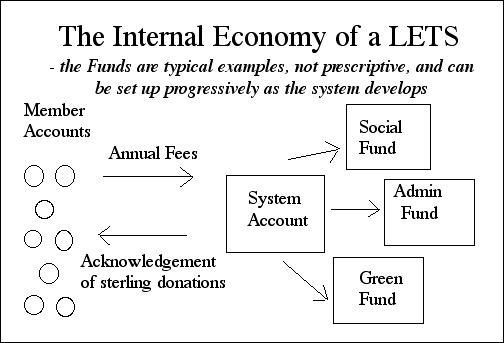
For example, from 100 accounts @12 units, one per month, you
can create a budget of 1200 units. Payments can then be made from
the system account into particular budgets, eg the Admin Fund
for administrative work, a Social Fund for helping at trade fairs
and running local socials, a Pastoral or Community Fund eg for
visiting sick members, etc, and, say, a Green Fund for environmental
projects, plus the Sterling Fund,as mentioned above. The process
can be started with perhaps an initial 200, then further amounts
as required. To keep these budgets in balance a Fund Manager may
be appointed for each of them. Time-sheets can be kept, and/or
the invoicing function can be used by individuals to make claims
for work done, and the Fund Manager, will have the password for
the specific "Fund" accounts and make the payments online. This
diagram summarises the procedure outlined above.
Positive Management and Engagement
It is important that core-group members understand and are confident
about these procedures. The naming and approving of the various funds is a positive
discussion that can engage members, and the fund managers will
report back at each committee meeting on how the budget has been
spent and ask for more if necessary. The advantages of adopting
these policies are that (a) poorly members can be taken care of
and not excluded from trading, (b) sterling funds can be raised
other than from subscriptions, (c) trading activities can be stimulated
by the organisers of the scheme, (d) they are a very useful mechanism
for outreaching into the mainstream community and engaging in
areas previously reserved for volunteering, and (e) you introduce
the idea of proper governance of LETS expenditure in the same
way as for sterling.
Enrolment and Renewal Procedures
The most elegant way of managing annual fees is to take them in
arrears, ie for the previous year, so that when you enrol a member, you compensate them for
charges that will be made annually. For example, if the fee-take is in January, and the
member joins in December, you will give them 11 units of Local
Currency when they join which means they will have paid the correct amount of
one unit per month (12-11=1), but if they enrol in June, you would make
this 6 units of currency (12-6=6). Together with acknowledgement of the sterling joining
fee, this works as a "sweetener" for new members, putting
a small amount into their account to give them the confidence
to begin trading from a positive base. For example, if the member joining in June
and paying £10 sterling would receive 16 units of local currency, which makes it fair
if you operate concessions, or allow some people to join for free.
Managing Members who become Inactive
NB There is an option in the system to switch off the listings
of members who have not logged on for a specified period of time,
eg six months or a year - it sends out a reminder which prompts
them to update their listings. This does not switch off their
account - you would have to de-activate it manually, but it does
reduce the out-of-datedness of offers on display, whilst still
allowing a fee-take from those members. NB if a member is no longer
engaging, it may be that they are ill and needs more support,
so it's always worth having a member-support or "Broker"
role on the core group to investigate what's happening with members
who are falling away, and find out how their needs can be met.
Additional Support for Funds
Members can also tithe into these budgets, via the system, which
is a way of engaging the generosity of members, and of making
LETS relevant to the community, enabling those who are high earners
to support other members.
Is All This Really Necessary?
There was an idea out there when LETS was first set up, that
systems would be self-managing. However, this was wishful thinking
in view of the complexity of these projects, which are a cross
between running a local bank and supporting a self-help system
of mutual aid. A high level of co-operation and inspiration is
needed for a multi-talented team to keep these systems moving
forward. In good economic times, the tendency is for members to
get to know each other and become friendly so that formal trading
falls off. This can be seen as some form of success, if all you
wanted to do is to form a social network. Alternatively, due to
mismanagement, a scheme can simply "hollow out" over
time, leaving the oligarchs with excess funds and nothing to spend
them on. For these reasons, it behoves us to learn how to develop
and manage LETS as sustainable economies, as they may become more
important, given the problems in the mainstream economy. The diagram
below attempts to summarise what we have described above.
Raising Sterling Funds
You can also use the "Exchange" function for raising sterling funds
at public events, by accepting cash for local currency vouchers,
enabling members of the public to immediately trade in the system,
and accounting for this from the System Account or Sterling Fund.
This can be used as a way of integrating with "Local Currency"
operating in some Transition Towns, but it should be noted that
it will contribute to the overall system deficit, as the funds
are not held as "backing" for the vouchers, but are
used to manage the scheme.
To summarise, people can join the system
at any time and a individual arrangement will be made to reconcile
their account in terms of exchange for a sterling donation, and to correct
for the timing of the annual renewal fee, which is is taken from the
accounts of all active members at the same time. The precise amounts
and procedures should be agreed by the committee. Payments can be
made, either from
the system account, or possibly from a new account specifically
for the purpose, which can be named the Sterling Fund (not yet
shown in the diagram below),
which illustrates the ongoing process of balancing sterling ond
local budgers:
LL/MF/ May 2010 - updated July 2012
|